Research Article | | Peer-Reviewed

Choice of Small-scale Catfish Farmers for Rearing System in Oyo State, Nigeria: A Comparative Analysis of SEAP Beneficiaries and Non-beneficiaries

Received: 26 February 2026     Accepted: 12 March 2026     Published: 20 April 2026
Views:       Downloads:
Abstract

The choice of rearing systems has important implications for productivity, profitability, and sustainability among small-scale fish farmers. This study analyses the determinants of rearing system choice among small-scale catfish farmers in Oyo State, Nigeria, with particular emphasis on the role of institutional support through the Self-Reliance Economic Advancement Programme (SEAP). Using cross-sectional data from 248 farmers (124 SEAP beneficiaries and 124 non-beneficiaries), we examine farmers’ choices among earthen, concrete, and collapsible ponds/other systems, using a multinomial logit model. The results indicate that access to credit, fish farming income, SEAP participation, farming experience, marital status, and primary occupation significantly influence the choice of rearing system. Farmers with greater access to credit and higher incomes are more likely to adopt capital-intensive systems, such as concrete and collapsible ponds, rather than earthen ponds. In contrast, more experienced and married farmers tend to remain with earthen ponds, reflecting risk considerations and path dependency. The findings underscore the importance of institutional and financial support for intensifying catfish farming and provide policy-relevant insights to inform the design of credit and extension programs for small-scale fish farmers.

Published in American Journal of Theoretical and Applied Business (Volume 12, Issue 2)
DOI 10.11648/j.ajtab.20261202.12
Page(s) 56-67
Creative Commons

This is an Open Access article, distributed under the terms of the Creative Commons Attribution 4.0 International License (http://creativecommons.org/licenses/by/4.0/), which permits unrestricted use, distribution and reproduction in any medium or format, provided the original work is properly cited.

Copyright

Copyright © The Author(s), 2026. Published by Science Publishing Group

Keywords

Aquaculture Systems, Catfish Farming, Multinomial Logit, Rearing Systems, Nigeria, SEAP

1. Introduction
Aquaculture is crucial for Nigeria's food security and economic growth. Catfish farming is prominent in aquaculture due to its high demand, rapid expansion, and adaptability across various farming systems . Small-scale catfish farming especially helps improve food security and provides income for rural and urban households . However, the choice of rearing system greatly impacts productivity, profitability, and sustainability. Small-scale farmers mainly use three rearing systems: earthen ponds, concrete tanks, and collapsible ponds. Each has different strengths and weaknesses regarding capital costs, management needs, and environmental suitability. The factors that influence farmers' choices for these systems are complex and often shaped by socioeconomic, institutional, and financial conditions.
Many small-scale farmers encounter obstacles that limit their production, including reduced access to capital , technical know-how , land , and environmental conditions . An effective rearing system can boost productivity and profitability . Various government and non-governmental programs have been launched to improve farmers' access to financing, technical training, and business sustainability . One notable initiative is the Self-Reliance Economic Advancement Programme (SEAP), established in 1998 and officially registered in 2000. SEAP is a non-profit, non-political, and non-religious organization that aims to promote sustainable livelihoods for marginalized communities. Its primary goal is to economically empower underprivileged groups, build capacity, and enhance the socioeconomic conditions of impoverished individuals. SEAP has played a vital role in supporting small and medium-sized enterprises in developing viable, market-oriented business frameworks . The Self-Reliance Economic Advancement Programme (SEAP) promotes fisheries and aquaculture by advancing financial inclusion, providing enterprise support, and building capacity for small-scale entrepreneurs. SEAP Microfinance Bank offers microcredit and savings services to fish farmers, processors, traders, and input suppliers without access to formal banking services. These services help producers invest in inputs such as fishponds, fingerlings, feed, and equipment, thereby boosting production and sustainability. SEAP also supports women in fish processing and marketing via group lending and cooperative financing, reducing risks and encouraging collective participation. It provides training in entrepreneurship and financial literacy to improve business skills and market engagement. Collaborations with organizations such as the World Bank, the International Fund for Agricultural Development (IFAD), and the United Nations Development Program (UNDP) support broader livelihood programs by strengthening value chains through increased access to finance, fostering entrepreneurship, adding value, and boosting income for smallholder fish farmers and related businesses.
Choosing an appropriate rearing system provides significant benefits to catfish farmers, especially through improved water quality management, leading to healthier fish and a lower disease risk . Well-designed systems, such as Recirculating Aquaculture Systems (RAS) or properly managed ponds, create optimal environmental conditions that promote faster growth, improved feed efficiency, and reduced mortality . Consequently, farmers can achieve higher yields, greater profitability, and more efficient use of resources, including water conservation. Additionally, effective rearing systems enhance disease control and biosecurity, supporting more sustainable and environmentally responsible aquaculture practices .
Careful selection and management of rearing systems are vital to the success of catfish farming. Empirical research is urgently needed to understand the factors shaping small-scale farmers' choices in Nigeria. Small-scale fish farming boosts food security, income, and employment . Demographics such as gender, age, education, and access to resources influence decisions about rearing systems . Farmers face challenges, including limited resources, poor infrastructure, and a lack of technical knowledge. Choosing between pond, cage, or pen culture critically affects productivity, profitability, and sustainability .
This study contributes to the aquaculture economics literature by analyzing the determinants of rearing system choice among small-scale catfish farmers in Oyo State, Nigeria, and by comparing SEAP beneficiaries and non-beneficiaries. Using a multinomial logit framework grounded in profit-maximization theory, the paper examines how socioeconomic characteristics, institutional participation, and financial access shape technology choices in small-scale aquaculture. The findings will inform the development of customized extension services, credit facilities, and other support programs to improve productivity and profitability in small-scale catfish farming in the area . This research could influence policies supporting small-scale fish farming in Oyo State, Nigeria, by deepening the understanding of farmers' choices of rearing systems. This understanding can guide targeted interventions to address sector challenges and promote sustainable, efficient practices. Consequently, it can enhance productivity, profitability, and sector sustainability, guiding effective policies for growth across Nigeria.
2. Materials and Methods
2.1. Theoretical Framework
This study is grounded in profit-maximization theory, which assumes that farmers select production systems that maximize expected profits subject to resource and institutional constraints . In catfish farming, producers choose among alternative rearing systems by comparing expected revenues and costs, including initial investment, operating expenses, and risk exposure. Capital-intensive systems, such as concrete and collapsible ponds, typically require higher upfront investment but may offer higher yields and better control over production conditions . Conversely, earthen ponds entail lower fixed costs but may yield lower productivity and pose greater environmental risk. Institutional interventions, such as access to credit and development programs, can alter farmers’ feasible choices by easing liquidity constraints and reducing information gaps. These factors affect fish growth, size, health, marketable output, and prices . For example, improved water management in controlled environments can produce healthier, faster-growing fish, increasing revenue. Farmers must also consider market demand for different catfish sizes and types when selecting profitable systems. Risk assessment is crucial, as challenges such as disease, water quality, and market price fluctuations can impact outcomes . The chosen rearing system shapes these risks. Intensive systems may increase production but also raise the risk of disease transmission if left unmanaged. Farmers balance these risks against potential profits to optimize gains and reduce losses. Governmental and NGO initiatives, such as SEAP, can support farmers by providing information and resources for profit-oriented, sustainable practices. The multinomial logit model used in this study captures these trade-offs by estimating the probability that a farmer selects a particular rearing system relative to a base category.
2.2. Study Area
Oyo State is one of the leading agricultural states in southwestern Nigeria, with a strong presence in aquaculture, particularly catfish farming. Geographically, it lies between latitudes 7°N and 9°N and longitudes 2.5°E and 5°E, covering approximately 28,454 km². It borders Osun, Ogun, Kwara, and Ondo, making it a strategic location for fish production and marketing. The state has a tropical climate with distinct wet and dry seasons, creating an ideal environment for fish farming. Oyo State is rich in water resources, including rivers, streams, and reservoirs, which provide a vital foundation for aquaculture. Major fish-producing regions include Ibadan, Oyo, Ogbomoso, Iseyin, and Saki, where small-scale farmers contribute significantly to fish production. Catfish farming is widely practiced, with farmers using earthen ponds, concrete tanks, and tarpaulin ponds to meet rising demand in both urban and rural markets. Market access, feed supply chains, and extension services influence farmers' choice of rearing systems. Oyo State is bordered to the north by Kwara State for 337 kilometers, to the southeast by Osun State for 187 kilometers, partially along the River Osun, to the south by Ogun State, and to the west by the Republic of Benin, spanning 98 kilometers. The economy of Oyo State is predominantly agricultural, with significant production of crops such as cassava, maize, cocoa, catfish, and tobacco.
2.3. Sampling Procedure and Sample Size
A multi-stage sampling procedure was used in this study. In the first stage, six Local Government Areas (LGAs) were purposively selected from the ten SEAP-beneficiary LGAs in Oyo State. These included Ido, Atiba, Egbeda, Oluyole, Akinyele, and Iseyin, chosen for their active small-scale catfish farming. Two fish-farming communities were purposively selected from each LGA, yielding a total of 12 communities in the second stage. A reconnaissance survey with SEAP officials identified loan beneficiaries in these areas. The Slovenian formula was used in the final stage to determine the sample size. A total of 248 farmers were randomly selected, comprising 124 SEAP beneficiaries and 124 non-beneficiaries. This approach ensures balanced representation by systematically comparing the factors influencing small-scale farmers' preferences across different catfish-rearing systems.
2.4. Source of Data
Primary data were collected using a semi-structured questionnaire administered through face-to-face interviews. The questionnaire consisted of closed-ended questions (multiple-choice and categorical responses) capturing socioeconomic characteristics, farm structure, institutional access, and production decisions. Limited open-ended questions documenting farmers’ production constraints and management experiences. Information collected included: demographic characteristics (age, sex, education, marital status); farm characteristics (experience, farm size, stock size, income); institutional variables (credit access, extension services, agricultural training, cooperative membership); participation in the Self-Reliance Economic Advancement Programme (SEAP); and type of rearing system adopted. The questionnaire was pre-tested in a non-sampled community to ensure clarity and reliability before full deployment.
2.5. Methods of Data Analysis
Descriptive and inferential statistics, including tables and frequencies, were used to achieve the study's objectives. Descriptive statistics were used to analyse the socioeconomic characteristics of catfish farmers. A multinomial logistic regression model was used to assess factors influencing catfish farmers' preferred rearing system. The multinomial logit regression model is appropriate when the dependent variable is nominal and has more than two categories that cannot be meaningfully ordered. The multinomial logit model was applied to represent the various rearing system categories among rice farmers in the study area. The values 1, 2, and 3 correspond to rented or leased land, personal land, and inherited land, respectively.
Therefore, this study categorised the types of rearing systems commonly adopted into three;
1) Earthen ponds
2) Concrete ponds
3) Collapsible and others
Following and , the probability that a farmer i chooses system jis given by:
P(Yi=j)=exp(Xiβj)1+k=12exp(Xiβk),j=1,2(1)
where Xiis a vector of explanatory variables including socioeconomic, institutional, and farm-level characteristics. For j = 1, 2… (k-1), the model parameters are estimated by the method of multinomial logit.
Note: In estimating the multinomial logit model, the collapsible pond system was designated as the reference (base) outcome category. This choice was motivated by its relatively low adoption rate compared with earthen and concrete pond systems, which dominate aquaculture production in the study area. Selecting the least frequently chosen alternative as the base category enables meaningful comparison of farmers’ relative probabilities of adopting more established rearing systems and improves the interpretability of marginal effects and coefficient estimates.
P = the number of explanatory variables included in the model.
In practice, when estimating the model, the coefficients for the reference group are normalized to zero . This is because the probability for all choices must sum to unity . Hence, for three choices, only (3 - 1) distinct parameter sets can be identified and estimated. Taking the natural logarithm of the odds ratios in equations (1) and (2) yields the estimating equation as:
P(Yi=j)=eXiβjk=0JeXiβk(2)
where Xias a vector of explanatory variables including socioeconomic and institutional characteristics, and βjas a vector of parameters to be estimated.
For j = 1, 2… (k-1), the model parameters are estimated by the method of multinomial logit.
The following sets of independent variables were put in the model.
X1 = Sex (Male=0, Female=1)
X2 = Age (Years)
X3 = Marital Status (Married=0, 1=Otherwise)
X4 = Education Level (Years)
X5 = Household (Number)
X6 = Farming experience (Years)
X7 = Primary occupation (Fish farming=0, 1=otherwise)
X8 = Total fish income (Naira)
X9 = Amount of credit received (Naira)
X10 = Cooperative association membership (Yes=0, No=1)
X11 = Access to extension (Yes=0, 1=No)
X12 = Access to Agricultural Training (Yes=0, No=1)
X13 = Participation in SEAP (Yes=0, 1=No)
X14 = Livelihood index
X15 =Farm size (Ha)
3. Results and Discussion
3.1. Socioeconomic Characteristics of SEAP Beneficiaries and Non-beneficiaries
The socioeconomic characteristics of the small-scale catfish farmers are presented in Table 1. It reveals key structural features of aquaculture production in Oyo State and provides context for understanding farmers’ choices of rearing systems. The results show that catfish farming in Oyo State is predominantly male-dominated, with males accounting for 89.52% of SEAP beneficiaries and 87.90% of non-beneficiaries. Female participation remains relatively low, reflecting ongoing gender-based barriers to accessing resources, including land, capital, and aquaculture infrastructure. The similar gender composition across both groups indicates that program participation does not significantly change existing gender dynamics but operates within current institutional structures. These findings align with those of , who reported that fish farming is predominantly male in the study area. The low presence of women in small-scale fish farming can be linked to their involvement in off-farm activities, such as food vending, hairdressing, tailoring, and petty trading.
The age distribution reveals that farmers are mainly within the economically active population, with average ages of 41 and 43 years for beneficiaries and non-beneficiaries, respectively. Most respondents fall within the 31–50 age range, indicating sufficient physical capacity and managerial maturity needed for aquaculture operations. The similar age structures of the two groups suggest that demographic factors alone are unlikely to explain differences in production decisions; instead, institutional and economic conditions may have a greater influence. This supports the assertion in that fish farmers in the study area are predominantly middle-aged and active. It indicates that the industry comprises energetic, capable individuals who can effectively handle the physical demands of farm work. This bodes well for the sector's sustainability and growth in the study area.
Marital status patterns further reveal that aquaculture is primarily practiced by household heads, with over 70% of respondents in both groups being married. Marriage may influence investment behaviours by increasing household responsibilities and risk considerations, potentially encouraging farmers to adopt production systems perceived as stable and less risky. This aligns with , who found that most small-scale fish farmers were settled family members with responsibilities. It also supports , who reported that most loans were given to married small-scale fish farmers. Educational attainment among farmers is relatively high, with most holding secondary or tertiary education. This suggests that farmers generally have the mental capacity to process technical information and adopt improved aquaculture methods when conditions such as finance and training are available. found that all respondents had some form of formal education and that educational level affected their awareness of modern fish farming practices.
Household sizes are relatively small, with most respondents reporting four or fewer members and an average of about two people per household. This explains the high dependence on hired labour seen among farmers, confirming the increasingly commercial nature of small-scale aquaculture in the area. In fact, hired labour accounts for over 80% of farm work among beneficiaries and nearly 80% among non-beneficiaries, indicating that fish farming extends beyond subsistence activities. This pattern suggests a potentially negative trend, highlighting the need for more hired labour, which contrasts with , who argued that larger family sizes are linked to a higher likelihood of sustainable labour, as family members contribute to the workforce.
Institutional access indicators show modest but meaningful differences between the two groups. Access to credit is slightly higher among SEAP beneficiaries, reflecting the program’s financial support to improve farmers’ investment capacity. This contradicts the claim of , who reported that most small-scale fish farmers lacked access to credit due to a scarcity of loanable funds. Instead, this study indicates that beneficiaries had better access to credit, possibly due to their participation in the program. Access to extension services remains moderate and similar across groups, suggesting that public advisory services are broadly available to farming communities rather than being specific to the program. Cooperative membership is also common among the farmers, emphasizing the importance of social networks in facilitating access to information, credit, and production inputs. These findings support ’s assertion that most small-scale farmers in the study area are members of a cooperative society.
Differences in farming experience suggest that SEAP participation may attract relatively newer entrants into aquaculture. While a significant proportion of beneficiaries have 10 years or less of farming experience, non-beneficiaries are more concentrated in the 11–20 years’ experience category. This pattern indicates that institutional support programs may play an important role in lowering entry barriers for emerging farmers seeking to expand production. Occupational structure further reinforces this observation, as a higher proportion of beneficiaries identify fish farming as their primary occupation. In contrast, non-beneficiaries show greater livelihood diversification through civil service and other activities. This result contradicts the assertion of , who affirmed that most aquaculture farmers in the study area were part-time fish farmers, highlighting the diversity of experience among small-scale fish farmers.
Land ownership patterns show relatively secure tenure arrangements, with most farmers working on land they own or have inherited. Secure land access reduces investment uncertainty and promotes the long-term development of aquaculture infrastructure. Production indicators also reveal clear differences between groups. Although average stock sizes are similar, beneficiaries earn higher incomes from fish farming, with their average annual earnings significantly surpassing those of non-beneficiaries. This income gap suggests that participating in the program may boost financial performance by improving access to capital and investment in production. Results further indicated that most beneficiaries (86.29%) and non-beneficiaries (79.84%) primarily used hired labour for farm work. This contradicts the findings of , who claimed that a household size of 5 people would make farming less labour-intensive due to the division of labour.
Overall, the socioeconomic profile shows that differences between SEAP beneficiaries and non-beneficiaries are influenced more by institutional access, commercialization levels, and financial capacity than by demographic traits. Beneficiaries exhibit greater involvement in aquaculture as their main livelihood and higher incomes, factors that likely influence the technology choices discussed in the following econometric analysis. These results emphasize the significance of targeted financial and institutional support in guiding production decisions among small-scale aquaculture farmers.
Table 1. Socioeconomic Characteristics of Oyo State SEAP Small-Scale Fish Farmers.

Variables

Beneficiaries

Non-beneficiaries

Sex

Frequency

Percent

Frequency

Percent

Female

13

10.48

15

12.10

Male

111

89.52

109

87.90

Age of the farmers

≥ 30

24

19.35

13

10.48

31-40

45

36.29

42

33.87

41-50

28

22.58

33

26.61

51-60

20

16.13

26

26.97

≥ 70

07

5.65

10

8.06

Mean

41

43

Min

27

28

Max

70

70

Marital status of the farmers

Not married

14

11.29

12

9.68

Married

88

70.97

94

75.81

Divorced

18

14.52

15

12.09

Separated

04

3.23

05

4.03

Level of education of the farmers

No formal education

01

0.80

00

0

Primary education

05

4.03

05

4.03

Secondary education

63

50.81

62

50.00

Tertiary education

55

44.35

57

45.97

Household size of the farmers

≤ 4

123

99.19

122

98.39

≥ 8

01

0.81

02

1.61

Mean

2

2

Min

0

0

Max

6

6

Access to credit

No

11

8.87

15

12.10

Yes

113

91.13

109

87.90

Access to extension services

No

52

41.94

56

45.16

Yes

72

58.06

68

54.84

Member of a farmers’ cooperative society

No

57

45.97

54

43.55

Yes

67

54.03

70

56.45

Years of fish farm experience

≤ 10

50

40.32

34

27.42

11-20

50

40.32

66

53.23

21-30

11

8.87

22

17.74

≥ 40

13

10.48

02

1.61

Mean

14

14

Min

6

7

Max

40

40

Primary occupation

Fish farming

42

33.87

28

22.58

Civil service

32

25.81

36

29.03

Artisan

24

19.35

32

25.81

Farming

24

19.35

31

25.00

Others

02

1.61

01

0.08

Source of land

Personal land

56

45.16

58

46.77

Inherited

52

41.94

47

37.90

Rented/leased

16

12.90

19

15.32

Stock size (stock density)

Mean

4,762

4,762

Min

200

200

Max

75,000

75,000

Primary Sources of Farm Labour

Family

17

13.71

25

20.16

Hired

107

86.29

99

79.84

Total Income from Fish Farming (₦)

Mean

2,145,714.00

1,178,671.00

Min

200,000.00

150,000.00

Max

18,000,000.00

5,000,000.00

Total

124

100

124

100

Source: Field survey, 2024
3.2. Types of Rearing System Adopted by the Farmers
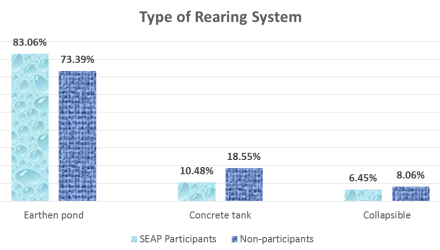
Figure 1 shows the types of rearing systems adopted by farmers. Regarding production technologies, earthen ponds remain the primary system for both groups, used by over 80% of beneficiaries and more than 70% of non-beneficiaries. However, the adoption of concrete tanks is slightly higher among non-beneficiaries, while collapsible ponds remain a minor but emerging system. The continued use of earthen ponds underscores their affordability, lower risk, and familiarity among small-scale farmers, while the gradual adoption of alternative systems indicates ongoing but uneven technological change within the aquaculture sector.
Figure 1. Types of Rearing System Adopted by the Farmers.
3.3. Factors Influencing the Choice of Rearing System Among Catfish Farmers in Oyo State, Nigeria
A multinomial regression model was used to examine the factors influencing the choice of rearing system among catfish farmers in Oyo State, Nigeria. A pseudo-R-squared of 0.254 indicates that the model's independent variables explain approximately 25.4% of the variation in the choice of rearing system. Although it is lower than the R-squared in linear regression, it indicates a reasonable model fit for this type of analysis . The chi-square test (χ² = 87.444, p < 0.000) examines the null hypothesis that all the coefficients in the model are zero. The highly significant p-value (p < 0.000) indicates that the model is significantly better at predicting the choice of rearing system than a null model with no predictors. Importantly, coefficients from the multinomial logit model capture changes in relative log-odds rather than marginal probability effects. Therefore, interpretations are framed in terms of likelihood relative to the base category, avoiding causal claims.
Agricultural Training: The coefficient for agricultural training was significant at the 10% level (p < 0.1). This suggests that farmers with access to agricultural training are more likely to prefer earthen ponds over concrete or collapsible ponds. Agricultural training can inform farmers about the benefits and management of different rearing systems, potentially leading them to adopt more modern and intensive systems .
Amount of Credit: The coefficient on credit is positive and statistically significant for capital-intensive systems relative to earthen ponds. This indicates that increased access to credit raises the likelihood of choosing concrete or collapsible ponds, consistent with the expectation that liquidity constraints limit adoption of capital-intensive technologies and .
Fish farming income: Higher income significantly increases the probability of selecting concrete ponds over earthen ponds, consistent with evidence that profitability and reinvestment capacity influence upgrading of production systems . This suggests that profitability and reinvestment capacity play a central role in system upgrading.
Participation in SEAP: SEAP participation is statistically significant in the concrete pond equation with a negative sign relative to earthen ponds. This implies that, holding other factors constant, SEAP beneficiaries are less likely to choose concrete ponds than earthen ponds. This result should be interpreted with caution: it does not imply that SEAP discourages intensification, but rather that program design, loan size, or risk considerations may favor incremental upgrading over the immediate adoption of concrete systems. This aligns with the findings of .
Farming experience: The negative, statistically significant coefficient in the concrete pond equation indicates that more experienced farmers are less likely to adopt concrete ponds than earthen ponds. This reflects path dependence and risk aversion among experienced producers who have accumulated knowledge and infrastructure tied to traditional systems .
Marital status: Married farmers are significantly less likely to choose concrete ponds relative to earthen ponds. This may reflect household risk preferences and competing financial obligations that constrain investment in capital-intensive systems. Those who are married may enjoy greater access to resources and labour, whereas single or divorced individuals may face limitations in these aspects. emphasised the importance of gender in their study.
Primary occupation: The coefficient was highly statistically significant (p < 0.001). Farmers whose primary occupation is non-farm employment are significantly more likely to choose concrete ponds relative to earthen ponds, suggesting that off-farm income relaxes capital constraints and facilitates the adoption of intensive systems. Concrete ponds may be perceived as requiring less land or being more manageable alongside other primary occupations. Alternatively, off-farm income may provide the necessary capital to invest in concrete ponds. Farmers' primary occupation is a motivating factor influencing their managerial ability .
Income: The income coefficient was statistically significant (p < 0.05). Higher total income is associated with a significantly increased likelihood of preferring concrete ponds over earthen ponds. This suggests that farmers with higher incomes from fish farming are less likely to prefer earthen ponds and more inclined to favour concrete or collapsible ponds. The marginal effects indicate that farmers with fish income are less likely to choose earthen ponds and more likely to choose concrete ponds. This finding aligns with those of .
Table 2. Multinomial regression model of factors influencing the preference for the Rearing Systems among Catfish farmers in Oyo State.

Variable

Coef.

St.Er.

t-value

p-value

Earthen Pond

Participation in SEAP

0.082

0.595

0.14

0.891

Livelihood index

-0.137

0.296

-0.46

0.643

Sex

0.706

0.881

0.80

0.423

Age

0.031

0.061

0.51

0.608

Education level

-0.044

1.681

-0.01

0.995

Marital status

-0.673

1.150

-0.59

0.558

Household size

0.32

0.551

0.58

0.561

Access to Agric Training

1.311*

0.718

1.82

0.068

Cooperative association

-.0485

0.832

-0.58

0.560

Farming experience

-0.119

0.097

-1.23

0.220

Pry occupation

1.132

0.858

1.32

0.187

Credit amount

0.000**

0.000

2.26

0.024

Farm size

0.000

0.000

0.80

0.422

Access to extension

-1.106

0.772

-1.43

0.152

Total income

0.000**

0.000

1.97

0.049

Constant

0.418

1.682

0.00

0.996

Concrete pond

Participation in SEAP

-1.199*

0.706

-1.70

0.090

Livelihood index

-0.470

0.369

-1.27

0.203

Sex

0.144

0.985

0.15

0.884

Age

0.115

0.077

1.50

0.132

Education level

-2.366

0.619

-0.00

0.999

Marital status

-2.487**

1.26

-1.97

0.048

Household size

0.727

0.634

1.15

0.252

Access to Agric Training

1.303

0.806

1.62

0.106

Cooperative association

-1.269

0.976

-1.30

0.194

Farming experience

-0.296**

0.128

-2.31

0.021

Pry occupation

1.882**

0.955

1.97

0.049

Credit amount

0.000

0.000

1.60

0.109

Farm size

0.000

0.000

0.65

0.518

Access to extension

-0.617

0.912

-0.68

0.499

Total income

0.000

0.000

-0.18

0.861

Constant

2.704

0.621

0.00

0.999

Pseudo r-squared

0.254

Chi-square

87.444

Prob > Chi2

0.000

Source: Computation from Stata. Note *** p<.01, ** p<.05, * p<.1
4. Conclusion and Recommendations
The study demonstrates that the choice of rearing system among small-scale catfish farmers in Oyo State is strongly shaped by financial capacity, institutional participation, and household characteristics. Access to credit and higher income facilitate the adoption of capital-intensive systems such as concrete and collapsible ponds. At the same time, experience and marital status are associated with continued reliance on earthen ponds.
From a policy perspective, the findings highlight the importance of tailoring credit and development programmes to farmers’ risk profiles and investment capacities, consistent with evidence from aquaculture development programmes in sub-Saharan Africa . Strengthening access to appropriately sized loans and complementary training could accelerate the sustainable intensification of catfish production without excluding risk-averse producers. Programmes such as SEAP can play a critical role in this process if aligned with farmers’ production realities and long-term investment pathways.
Annex
Post-estimation (Multicollinearity Test)
The Variance Inflation Factor (VIF) results indicate no significant multicollinearity among the explanatory variables in the model. VIF values range from 1.040 to 6.130, with an average of 2.530, which is below the common multicollinearity threshold of 10. Additionally, the tolerance values (1/VIF) are all above 0.10, confirming that the independent variables are not highly correlated. Overall, the results indicate that the model is free of serious multicollinearity and that the regression estimates are reliable.
Table 3. Variance Inflation Factor (VIF).

Variable

VIF

1/VIF

Participation in SEAP

6.130

0.163

Livelihood index

5.070

0.197

Sex

4.050

0.247

Age

3.630

0.275

Education level

3.270

0.306

Marital status

3.110

0.322

Household size

1.780

0.561

Access to Agric Training

1.420

0.704

Cooperative association

1.400

0.714

Farming experience

1.180

0.850

Pry occupation

1.170

0.854

Credit amount

1.080

0.929

Farm size

1.060

0.945

Access to extension

1.040

0.964

Mean VIF

2.530

Abbreviations

IFAD

International Fund for Agricultural Development

IITA

International Institute of Tropical Agriculture

NGOs

Non-governmental Organisations

RAS

Recirculating Aquaculture Systems

SEAP

Self-Reliance Economic Advancement Programme

UNDP

United Nations Development Program

VIF

Variance Inflation Factor

Author Contributions
Olanipekun Oluwabunmi Adegboyega: Conceptualization, Data curation, Investigation, Methodology, Project administration, Resources, Software, Supervision, Validation, Visualization, Writing – original draft, Writing – review & editing
Fasakin Idowu James: Conceptualization, Data curation, Formal Analysis, Investigation, Methodology, Project administration, Resources, Software, Supervision, Validation, Visualization, Writing – original draft, Writing – review & editing
Conflicts of Interest
The authors declare no conflicts of interest.
References
[1] Ogunji, J. O., & Wuertz, S. (2023). Aquaculture in Nigeria: Challenges, opportunities, and the way forward. Aquaculture, 456, 1–15.
[2] George F. O., Olaoye J. O., P. O. Akande, and Oghobase R. R. (2010). Determinants of aquaculture fish seed production and development in Ogun State, Nigeria. Journal of Sustainable Development in Africa. 12(8) 2010.
[3] World Bank. (2023). Financing Sustainable Aquaculture Development. World Bank, Washington, DC.
[4] FAO (2022): Empowering smallholder farmers to access digital agricultural extension and advisory services, Rome, Italy.
[5] UN-Habitat. (2021). World Cities Report 2021: The Value of Sustainable Urbanization. United Nations Human Settlements Programme.
[6] IPCC. (2020). Climate Change 2020: Impacts, Adaptation, and Vulnerability. Intergovernmental Panel on Climate Change.
[7] Manam, V. K. (2023). Fish Feed Nutrition and Its Management in Aquaculture. International Journal of Fisheries and Aquatic Studies, 11(2), 58–61.
[8] OECD. (2024). Aquaculture development in Africa: Policies, regulations, and institutions. OECD Publishing.
[9] SEAP Annual Report. (2023). Self-Reliance Economic Advancement Programme Annual Report 2023. SEAP, Zaria, Nigeria.
[10] Manyise, T., Kasanga, G., Ghazali, S., Yossa, R., & Rossignoli, C. M. (2024). Baseline characterization of the practices and use of fish feed ingredients among fish farmers in Zambia. CGSpace.
[11] Magesi, B. C., Muluvi, A. S., & Bett, H. K. (2025). Determinants of choice of climate-smart aquaculture Practices: Insights from smallholder fish farmers in Kakamega County, Kenya. Aquaculture Fish and Fisheries, 5(4).
[12] Li, H., Cui, Z., Cui, H., Bai, Y., Yin, Z., & Qu, K. (2023). A review of influencing factors on a recirculating aquaculture system: Environmental conditions, feeding strategies, and disinfection methods. Journal of the World Aquaculture Society, 54(3), 566–602.
[13] Lal, J., Vaishnav, A., Deb, S., Kashyap, S., Debbarma, P., Devati, N., Gautam, P., Pavankalyan, M., Kumari, K., & Verma, D. K. (2024). Re-Circulatory Aquaculture systems: a pathway to sustainable fish farming. Archives of Current Research International, 24(5), 799–810.
[14] Chandhana, B. L., Vijayan, A., & Kumar, V. J. R. (2025). Biosecurity in Aquaculture. In Biosecurity in Aquaculture (pp. 335–358).
[15] Boyd, C. E., D’Abramo, L. R., Glencross, B. D., Huyben, D. C., Juarez, L. M., Lockwood, G. S., McNevin, A. A., Tacon, A. G. J., Teletchea, F., Tomasso, J. R., Tucker, C. S., & Valenti, W. C. (2020). Achieving sustainable aquaculture: Historical and current perspectives and future needs and challenges. Journal of the World Aquaculture Society, 51(3), 578–633.
[16] Magna, J. A., Maina, J. G., & Ngugi, C. C. (2023). Factors Influencing Fish Farmers' Choice of Aquaculture Production Systems in Kenya. Aquaculture Economics & Management, 27(1), 1-20.
[17] Kaleem, O., & Sabi, A. B. S. (2020). Overview of aquaculture systems in Egypt and Nigeria, prospects, potentials, and constraints. Aquaculture and Fisheries, 6(6), 535–547.
[18] Samson, A., & Obademi, O. (2018). The Determinants and Impact of Access to Agricultural Credit on Productivity by Farmers in Nigeria: Evidence from Oyo State, Nigeria. Advances in Social Sciences Research Journal, 5(3).
[19] Ellis, F. (1993). Peasant economics: Farm households and agrarian development. Cambridge University Press.
[20] De Silva, S. S. and Anderson, T. A. (1995). Fish Nutrition in Aquaculture. Chapman and Hall, London.
[21] Timmons, M. B., & Ebeling, J. M. (2013). Recirculating aquaculture. Ithaca Publishing Company LLC.
[22] Mishra, B. P., & Singh, O. P. (2025). Factors Influencing the Choice of Agricultural Information Sources among Banana Farmers in Chitwan District, Nepal. Journal of Agriculture and Forestry University, 6(1), 58–66.
[23] Kent, G. (1997). Fisheries, Food Security, and the Poor. Food Policy, 22, 393–404.
[24] Ojo, M. A., Nmadu, J. N., Tanko, L., and Olaleye, R. S. (2013). Multinomial Logit Analysis of Factors Affecting the Choice of Enterprise among Smallholder Yam and Cassava Farmers in Niger State, Nigeria. 4(1), 7–12.
[25] Rahji, M. A. Y, and S. A. Fakayode (2009). A Multinomial Logit Analysis of Agricultural Credit Rationing by Commercial Banks in Nigeria. International Research Journal of Finance and Economics 24, 91.
[26] Greene, W. H (1993). Econometric Analysis. London: Macmillan.
[27] Kimhi (1994). "Participation Of Farm Owners in Farm and Off‐Farm Work Including the Option Of Full‐Time Off‐Farm Work," Journal of Agricultural Economics, Wiley Blackwell, 45(2), 232–239,
[28] Akerele, E. O., Ilori, A. R., Fadipe, M. O., Oluwasanya, O. P., & Ayodele, J. O. (2019). Effects Of Cooperative Loan On Small-Scale Fish Farming Business in Oyo State, Nigeria, Journal of Social Sciences, Kampala International University. 5(3): 7–17.
[29] Iroegbu, A. O. C., Ray, S. S., Mbarane, V., Bordado, J. C., & Sardinha J. P. (2021). Plastic Pollution: A Perspective on Matters Arising: Challenges and Opportunities. In: Bordado, J. C., & Sardinha, J. P. (eds), Plastic Pollution: A Perspective on Matters Arising. Springer.
[30] Enimu, S., Eyo, E. O., & Ajah, E. A. (2017). Determinants of loan repayment among agricultural microcredit finance group members in Delta State, Nigeria. Financial Innovation, 3(1).
[31] Etuk, E. A., Ogban, G. O., & Idiong, C. I. (2021). A comparative economic analysis of aquaculture production systems in the Southern Agricultural Zone of Cross River State, Nigeria. African Journal of Agricultural Research, 17(1), 104–111.
[32] Hair, J. F., Hult, G. T. M., Ringle, C. M., & Sarstedt, M. (2022). A primer on partial least squares structural equation modeling (PLS-SEM). Sage Publications.
[33] Inoni, O. E., Chukwuji, C. O., Ogisi, O. D., & Oyaide, W. J. (2017). Determinants of market participation and sales volume of fish in Delta State, Nigeria. Journal of Agriculture and Social Research (JASR), 6(1), 41–51.
[34] Adegbola, Y. P., Crinot, G. F., & Arouna, A. (2022). Fish farming system diversity and implications in the Republic of Benin: Types of fish farms and their economic performance. Aquaculture Fish and Fisheries, 2(6), 522–539.
[35] Gichuki, N. W., Ogada, M. J., Langat, D. K., & Nyangena, W. (2025). Determinants of the choice of aquaculture production systems among fish farmers in Kenya. Aquaculture Economics & Management, 29(1), 1–20.
[36] Omeje, V. O., Nwankwo, C. F., & Ugwu, L. L. (2020). Aquaculture Production Practices in Enugu State, Nigeria. Journal of veterinary and applied science. 24(3), 277–294.
[37] Ainembabazi, J. H., & Mugisha, J. (2014). The Role of Farming Experience on the Adoption of Agricultural Technologies: Evidence from Smallholder Farmers in Uganda. The Journal of Development Studies, 50(5), 666–679.
[38] Goswami, P., Noman, M. R. A. F., Islam, M. S., & Huda, S. (2020). Use of fish-farming practices by fish farmers. Research in Agriculture, Livestock and Fisheries, 7(3), 565–576.
[39] Kruijssen, F., McDougall, C. L., & Van Asseldonk, I. J. (2017). Gender and aquaculture value chains: A review of key issues and implications for research. Aquaculture, 493, 328–337.
Cite This Article
  • APA Style

    Adegboyega, O. O., James, F. I. (2026). Choice of Small-scale Catfish Farmers for Rearing System in Oyo State, Nigeria: A Comparative Analysis of SEAP Beneficiaries and Non-beneficiaries. American Journal of Theoretical and Applied Business, 12(2), 56-67. https://doi.org/10.11648/j.ajtab.20261202.12

    Copy | Download

    ACS Style

    Adegboyega, O. O.; James, F. I. Choice of Small-scale Catfish Farmers for Rearing System in Oyo State, Nigeria: A Comparative Analysis of SEAP Beneficiaries and Non-beneficiaries. Am. J. Theor. Appl. Bus. 2026, 12(2), 56-67. doi: 10.11648/j.ajtab.20261202.12

    Copy | Download

    AMA Style

    Adegboyega OO, James FI. Choice of Small-scale Catfish Farmers for Rearing System in Oyo State, Nigeria: A Comparative Analysis of SEAP Beneficiaries and Non-beneficiaries. Am J Theor Appl Bus. 2026;12(2):56-67. doi: 10.11648/j.ajtab.20261202.12

    Copy | Download

  • @article{10.11648/j.ajtab.20261202.12,
      author = {Olanipekun Oluwabunmi Adegboyega and Fasakin Idowu James},
      title = {Choice of Small-scale Catfish Farmers for Rearing System in Oyo State, Nigeria: A Comparative Analysis of SEAP Beneficiaries and Non-beneficiaries},
      journal = {American Journal of Theoretical and Applied Business},
      volume = {12},
      number = {2},
      pages = {56-67},
      doi = {10.11648/j.ajtab.20261202.12},
      url = {https://doi.org/10.11648/j.ajtab.20261202.12},
      eprint = {https://article.sciencepublishinggroup.com/pdf/10.11648.j.ajtab.20261202.12},
      abstract = {The choice of rearing systems has important implications for productivity, profitability, and sustainability among small-scale fish farmers. This study analyses the determinants of rearing system choice among small-scale catfish farmers in Oyo State, Nigeria, with particular emphasis on the role of institutional support through the Self-Reliance Economic Advancement Programme (SEAP). Using cross-sectional data from 248 farmers (124 SEAP beneficiaries and 124 non-beneficiaries), we examine farmers’ choices among earthen, concrete, and collapsible ponds/other systems, using a multinomial logit model. The results indicate that access to credit, fish farming income, SEAP participation, farming experience, marital status, and primary occupation significantly influence the choice of rearing system. Farmers with greater access to credit and higher incomes are more likely to adopt capital-intensive systems, such as concrete and collapsible ponds, rather than earthen ponds. In contrast, more experienced and married farmers tend to remain with earthen ponds, reflecting risk considerations and path dependency. The findings underscore the importance of institutional and financial support for intensifying catfish farming and provide policy-relevant insights to inform the design of credit and extension programs for small-scale fish farmers.},
     year = {2026}
    }
    

    Copy | Download

  • TY  - JOUR
    T1  - Choice of Small-scale Catfish Farmers for Rearing System in Oyo State, Nigeria: A Comparative Analysis of SEAP Beneficiaries and Non-beneficiaries
    AU  - Olanipekun Oluwabunmi Adegboyega
    AU  - Fasakin Idowu James
    Y1  - 2026/04/20
    PY  - 2026
    N1  - https://doi.org/10.11648/j.ajtab.20261202.12
    DO  - 10.11648/j.ajtab.20261202.12
    T2  - American Journal of Theoretical and Applied Business
    JF  - American Journal of Theoretical and Applied Business
    JO  - American Journal of Theoretical and Applied Business
    SP  - 56
    EP  - 67
    PB  - Science Publishing Group
    SN  - 2469-7842
    UR  - https://doi.org/10.11648/j.ajtab.20261202.12
    AB  - The choice of rearing systems has important implications for productivity, profitability, and sustainability among small-scale fish farmers. This study analyses the determinants of rearing system choice among small-scale catfish farmers in Oyo State, Nigeria, with particular emphasis on the role of institutional support through the Self-Reliance Economic Advancement Programme (SEAP). Using cross-sectional data from 248 farmers (124 SEAP beneficiaries and 124 non-beneficiaries), we examine farmers’ choices among earthen, concrete, and collapsible ponds/other systems, using a multinomial logit model. The results indicate that access to credit, fish farming income, SEAP participation, farming experience, marital status, and primary occupation significantly influence the choice of rearing system. Farmers with greater access to credit and higher incomes are more likely to adopt capital-intensive systems, such as concrete and collapsible ponds, rather than earthen ponds. In contrast, more experienced and married farmers tend to remain with earthen ponds, reflecting risk considerations and path dependency. The findings underscore the importance of institutional and financial support for intensifying catfish farming and provide policy-relevant insights to inform the design of credit and extension programs for small-scale fish farmers.
    VL  - 12
    IS  - 2
    ER  - 

    Copy | Download

Author Information
  • Abstract
  • Keywords
  • Document Sections

    1. 1. Introduction
    2. 2. Materials and Methods
    3. 3. Results and Discussion
    4. 4. Conclusion and Recommendations
    Show Full Outline
  • Abbreviations
  • Author Contributions
  • Conflicts of Interest
  • References
  • Cite This Article
  • Author Information